Nov 2025 · 6 min read
How I write hooks that stop the scroll
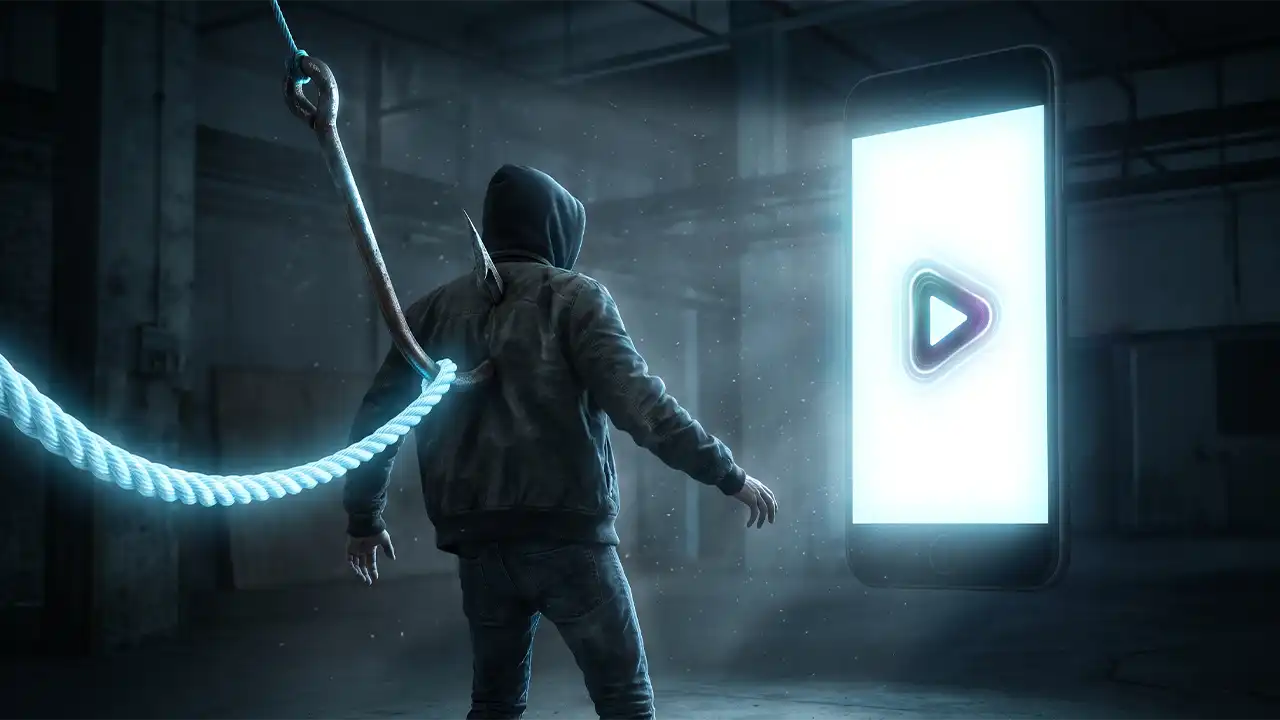
You have about two seconds. Not two seconds to explain the product, not two seconds to build a brand — two seconds to give someone a reason not to keep scrolling. That's the whole job of a hook, and most ads never get past it.
I used to think the hook was a line you wrote at the top of the script. Now I think of it as a decision the viewer's thumb makes before their brain even catches up. By the time they've consciously registered what the ad is about, they've already decided whether to stay. The hook isn't the introduction to the ad. It is the ad, for the first two seconds, and everything after it only exists if the hook did its job.
The mistake almost every brand makes
Most hooks are written for the brand, not for the scroll. They open with the product name, the category, or a line that only makes sense if you already care. "Introducing the serum that's changing skincare" is not a hook. It's a press release nobody asked to read. It assumes attention instead of earning it.
The scroll doesn't owe you context. It owes you nothing. So the hook has to work on its own, stripped of any assumption that the viewer knows or cares who you are.
Where I actually start
I never start with the product. I start with the objection, or the identity marker, that's already living in the customer's head.
- What are they already annoyed about?
- What do they think about themselves that the product either confirms or contradicts?
- What's the sentence a friend would say to them, not a brand?
If I can find the thing they were already thinking — mid-scroll, half-distracted — and put it on screen in the first second, I don't need a clever line. The recognition does the work. That's the difference between a hook that interrupts and a hook that just... starts.
Writing volume before writing "the one"
I don't sit down looking for the perfect hook. I write fifteen to twenty variants, fast, without judging them on the way out. Some are visual-first, some are copy-first, some are a single word on screen. The goal at this stage isn't quality, it's range — because the winning hook is rarely the one that sounded smartest in my head. It's usually the blunt one I almost cut for being "too simple."
Then I go through and kill anything that needs a second sentence to land. If a hook only makes sense after the follow-up line, it's not a hook, it's a setup. That's a hard filter, and it removes more than half of what I write on the first pass.
Four hook shapes I keep coming back to
These aren't rules, just patterns that keep testing well across different accounts:
The curiosity gap. Open mid-thought, mid-action, or mid-sentence. Nothing resolves in the first beat. The viewer stays to find out what they walked into.
The callout. Name the exact person watching — their situation, their habit, their frustration — specifically enough that it feels like it was written for one person, not a demographic.
The contrarian claim. Say the thing that goes against what the category usually tells people. Not for shock value — because it signals "this isn't the same pitch you've already ignored ten times."
The relatable pain point. State the annoying, unglamorous, specific version of the problem. Not "tired of dull skin" — the actual, textured complaint a real person would type in a group chat.
Visual pattern interrupts do the same job as copy hooks, and I try to stack both wherever possible — an unexpected object in frame, a jump cut before the first word, a close-up that doesn't immediately explain itself. The eye stops before the brain has decided whether to care.
Testing is the real writing process
I don't fall in love with a hook until the data tells me to. Hook rate — how many people watch past the first few seconds — is the only opinion that matters early on. I'll run three to five hook variants against the same body copy, let the numbers separate them, and only then start optimizing the winner further. Writing the hook is a hypothesis. Testing is the edit.
The hook is a promise
A good hook makes an implicit promise: stay, and this will be worth it. If the rest of the ad doesn't deliver on whatever tension the hook created, you get a great hook rate and a terrible conversion rate — which is its own kind of failure, just a slower one to diagnose. The hook isn't a trick to borrow attention. It's the first line of a deal you have to keep for the next twenty seconds.
That's the whole craft, really. Not writing clever lines — writing the exact sentence someone was already thinking, before they knew an ad was about to say it back to them.