Aug 2025 · 5 min read
The 3-part script structure I use for every ad
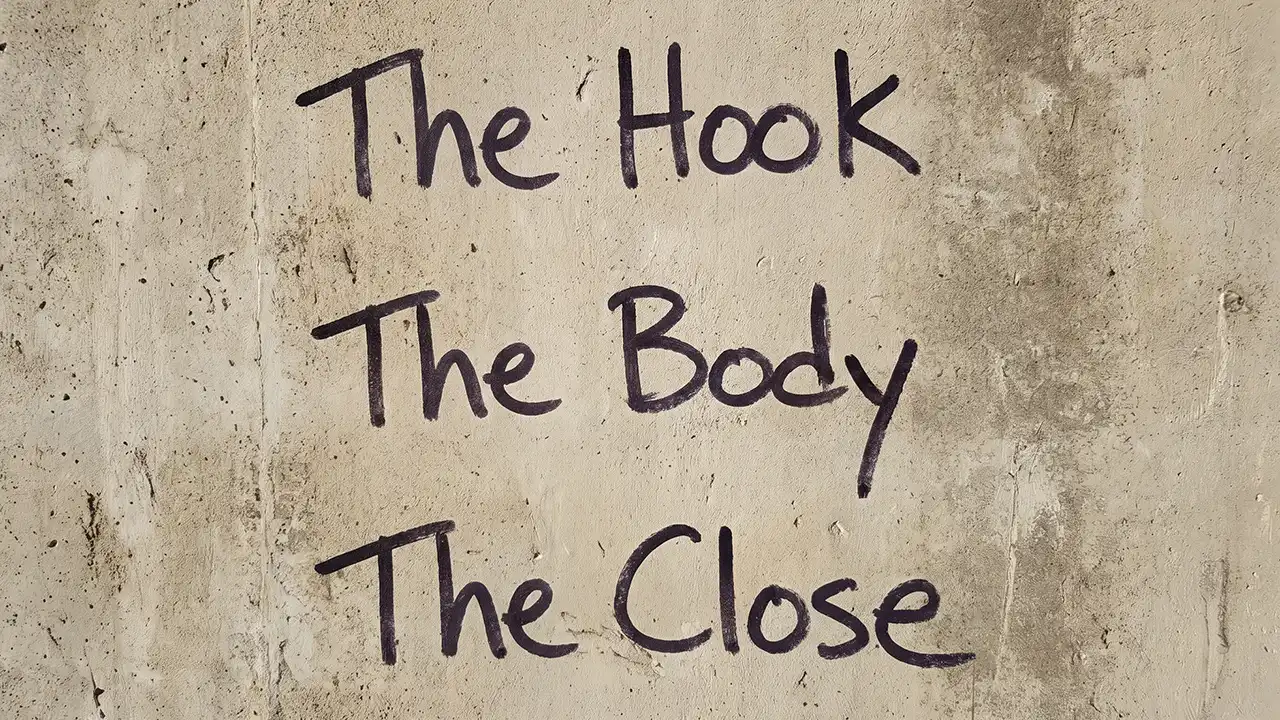
Every script I write, whether it's a fifteen-second native ad or a six-minute VSL, follows the same three-part skeleton. The length changes. The proportions change. The structure doesn't.
Hook. Body. Close. It sounds almost too simple to be a strategy. But most ads that underperform aren't failing because the idea was bad — they're failing because one of these three parts is missing, out of order, or trying to do a job that belongs to a different part.
Part 1: The Hook
I've written a whole piece on this one, so I won't repeat all of it here — but the short version is that the hook's only job is to earn the next three seconds. It doesn't sell, it doesn't explain, it doesn't introduce the brand. It creates a reason to keep watching. Everything else in the script is irrelevant if this part doesn't work, which is exactly why I write it last, even though it plays first — I need to know what the body is actually proving before I know what tension to open with.
Part 2: The Body — Problem, Agitate, Mechanism, Proof
This is where most of the actual persuasion happens, and it has its own internal order that I rarely break.
Problem. Name the specific, textured version of what the viewer is dealing with — not the category-level problem, the exact daily version of it. "Low energy" is a category. "Hitting a wall at 3pm and reaching for a third coffee you don't even want" is a problem someone recognizes.
Agitate. Sit in that problem long enough for it to feel real, without milking it so long the viewer disengages. This isn't about manufacturing pain — it's about making sure the viewer feels understood before you offer them anything.
Mechanism. This is the part most scripts skip, and it's the one that actually earns belief. Don't just claim the product works — name why it works, in a way that feels specific to this product rather than generic to the category. A named mechanism (a specific ingredient, process, or method) gives the viewer's skepticism something to hold onto instead of just asking them to trust you.
Proof. Now back up the mechanism — results, specificity, a real person's experience, a number that isn't rounded to sound impressive. Proof works best right after mechanism, because the viewer just formed a belief and proof locks it in before doubt creeps back.
Part 3: The Close
The close has one job: remove the last reason not to act. That usually means restating the offer plainly, adding a genuine reason to act now rather than later, and giving an unambiguous next step. This is not the place for a new idea, a new angle, or a clever final line. Novelty at the close creates hesitation. Clarity closes.
A lot of scripts try to make the close "creative" — and it almost always costs conversions. By the time someone reaches the close, they've already decided how they feel about the offer. The close's job isn't to persuade further. It's to make acting effortless.
Why the order matters more for cold traffic
This structure isn't arbitrary — the order matters specifically because cold traffic has zero context walking in. They don't know your mechanism, don't trust your brand, and haven't pre-decided they have the problem you're solving. Warm audiences can skip steps because trust and awareness already exist. Cold traffic can't skip anything, which is exactly why the order — hook, then problem, then agitation, then mechanism, then proof, then close — has to hold. Break the order, and you're asking someone to trust a mechanism before they've felt the problem, or act on an offer before they believe the mechanism works.
A quick walkthrough
Say the product is a magnesium supplement for sleep.
- Hook: "I didn't realize I hadn't had a full night's sleep in four years until I fixed one thing."
- Problem/Agitate: The 3am wake-ups, the wired-but-tired feeling, the coffee dependence that's actually a symptom.
- Mechanism: A specific magnesium form that crosses into the nervous system differently than the type most supplements use.
- Proof: A specific, unpolished result — not "life-changing," but something like "asleep before I finish the podcast episode now."
- Close: Plain offer restate, a real reason to act now (limited stock, intro pricing), one clear next step.
Same skeleton, whether that's a 15-second cut or a 5-minute VSL — just compressed or expanded depending on the format.
The takeaway
Hook earns attention. Body earns belief. Close removes friction. Miss one, and the other two are doing work they were never built to do — which is usually why an ad "should have worked" on paper and didn't. The structure isn't the creative part. It's the frame that makes the creative part actually convert.